Pay Yourself First
When I first started working in the finance world, the best piece of advice I ever received was to pay yourself first.
Take ownership of your financial future while you still have the biggest advantage on your side: time.
When you have the health.
When you have the energy.
Before the nicer house.
Before the new car.
Before the trip overseas.
Before you DoorDash $47 for Taco Bell that you don't ever eat because you fell asleep during delivery and the guy couldn't get in (definitely was not me).
Take some of the money you made and make sure you don't have to keep working to pay for your lifestyle later in life.
That sounds obvious, but I think a lot of people simply don't do it at all.
They get paid, live their life for the month, and then whatever happens to be left over gets saved.
The problem is there usually isn’t anything left. Sometimes there’s less than nothing.
Your Lifestyle Will Spend Whatever You Give It
This is probably the biggest reason paying yourself first matters.
If you make $5,000 per month and have the full $5,000 sitting in your checking account, it’s very easy to slowly build a $5,000-per-month lifestyle.
Make $8,000 and somehow life starts costing $8,000.
Make $15,000 and suddenly things that used to sound ridiculous start feeling completely normal.
There is always something else to spend money on. There is always something slightly nicer than what you're used to.
Paying yourself first lets you keep building for the future but also not completely restrict your today.
If $1,000 automatically leaves your account every month and gets invested, you stop thinking of yourself as someone with $5,000 to spend.
You have $4,000.
The investment becomes the bill that gets paid first.
Future You Needs a Paycheck Too
This is the part that has always made investing click for me.
I don't just look at an investment account as some number I'm trying to make bigger.
I look at it as future income.
If you eventually build a portfolio worth a few million dollars, that money can potentially produce tens or even hundreds of thousands of dollars per year for you in retirement.
Without you having to go to work for every dollar of it.
And depending on how much you withdraw and how the portfolio performs, you may still be able to preserve or grow a meaningful portion of it. The bigger the number, the more flexibility you have to spend and potentially pass something down.
Given enough time, consistency and income to invest, building something meaningful to pass down is more achievable than a lot of people realize.
That makes spending money today feel completely different.
You're not just deciding between:
Spend $10,000
or
Save $10,000
You're deciding between spending $10,000 today or giving that $10,000 decades to compound into something that could help pay you every month for the rest of your life.
That doesn't mean never spend the $10,000.
My whole philosophy is about actually enjoying your life.
But at least understand what you're trading away today.
Fill the Roth First
The way I like thinking about this is really simple.
Every year, the first chunk of money I invest goes toward filling the Roth IRA.
After the Roth is filled, anything else you're investing can keep flowing into your other investment accounts.
The important part isn't obsessing over which account gets every last dollar.
It's building the habit that investing happens before discretionary spending, not after it.
Because if you're waiting to invest whatever is left at the end of the month, you're betting against your own ability to find something to spend it on.
I would not take that bet.
I Built a Tool for This
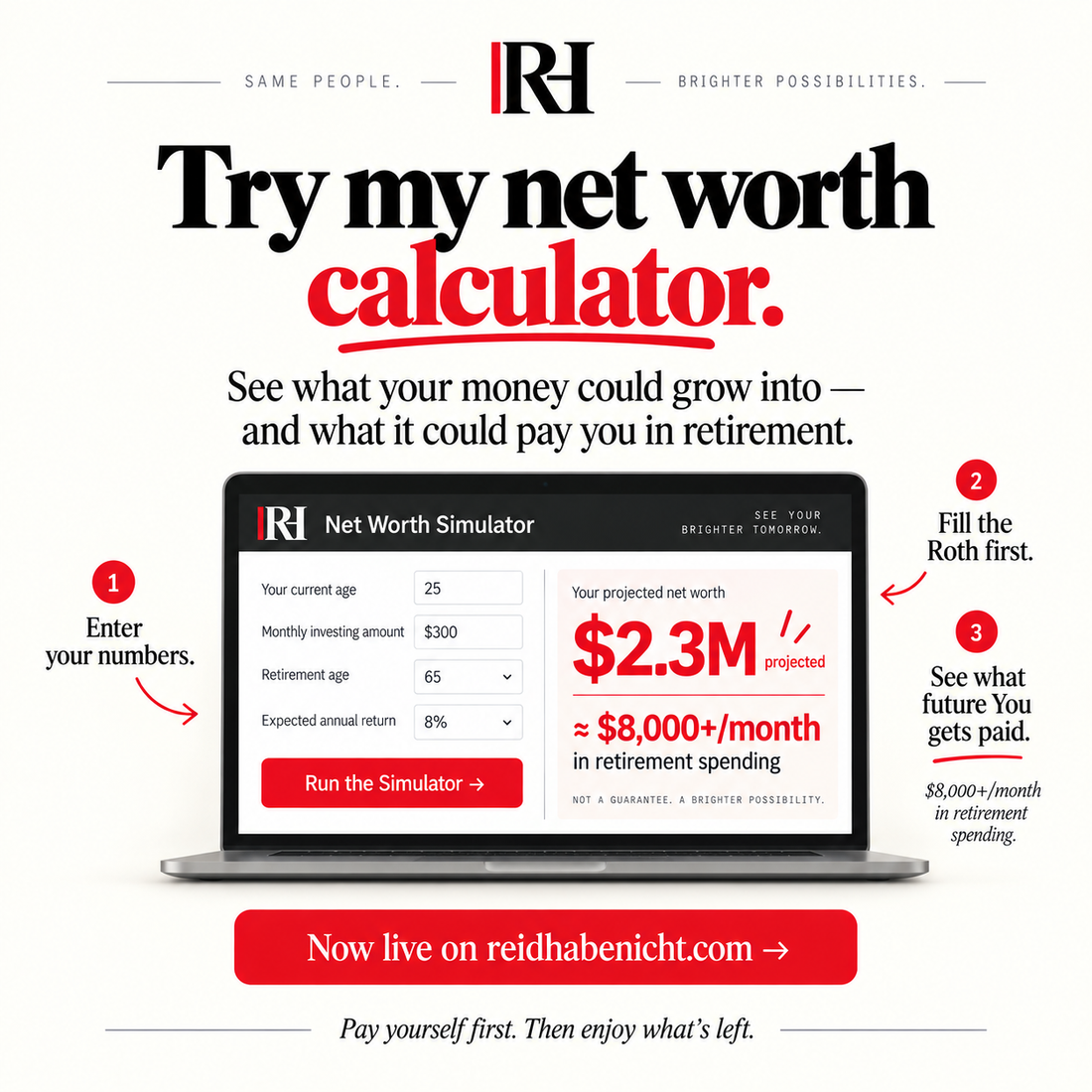
This is also why I built the Net Worth Simulator on the site.
You can enter:
- how old you are
- how much you already have invested
- how much you're investing each month
- when you want to retire
- what return you want to assume
And it'll show you what that could eventually become.
More importantly, it'll show you what that portfolio could potentially support in annual and monthly retirement spending.
Because I think:
$2.3 million
is cool.
But:
This could be around $8,000+ per month in retirement spending
puts it in a much better perspective.
There's also a section where you can see what investing another $500 per month could do, or what spending $10,000 today could potentially cost you.
Again, the answer isn't always:
Don't spend the money.
Sometimes The THING now is worth it.
Just make sure Current You isn't taking everything before Future You gets paid.
Pay yourself first. Then enjoy what's left. Not the other way around.