Everyone Is a Founder Now
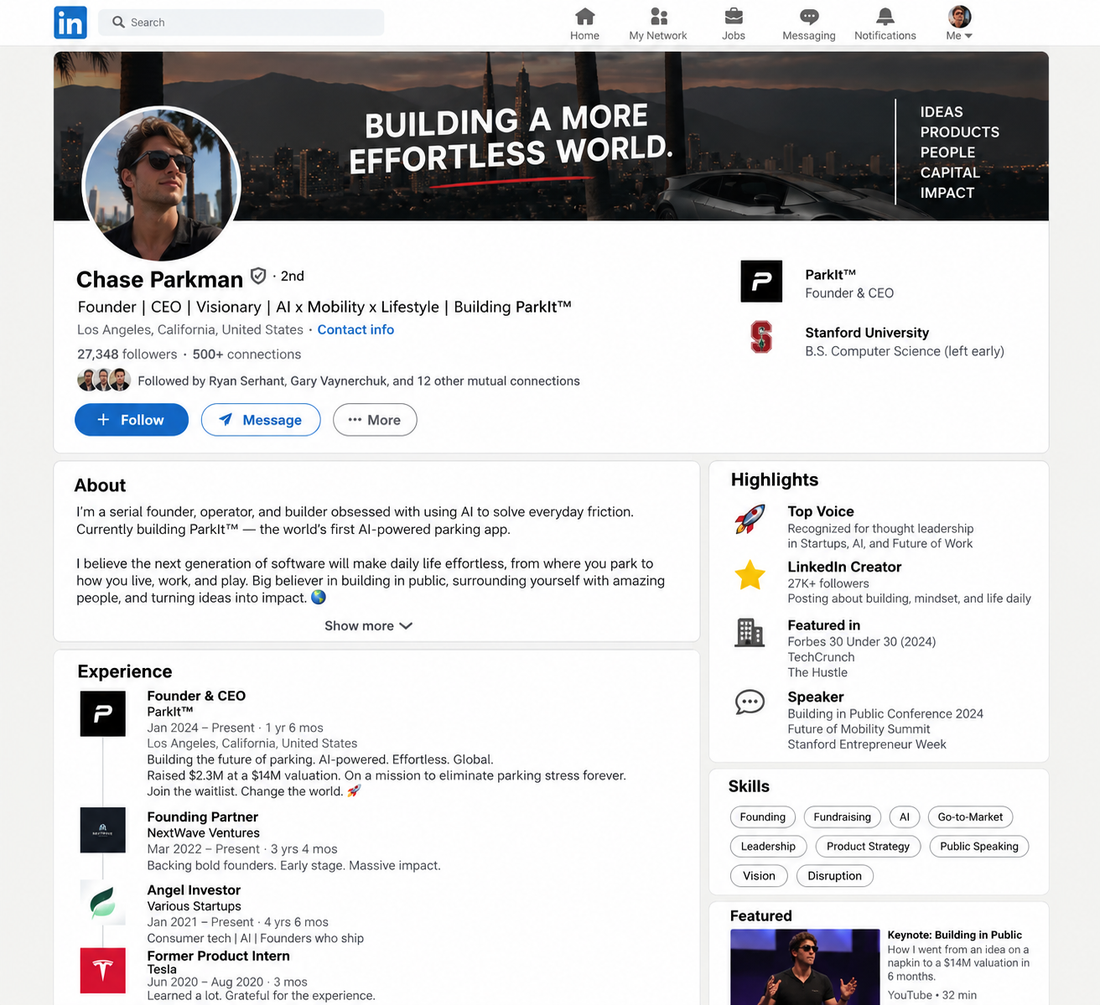
The new greatest buzzword in the world of entrepreneurship is “Founder” and it is getting dangerously close to meaning absolutely nothing.
If you’ve ever been on LinkedIn for longer than 5 minutes, you’ve probably run across some post where some guru is telling you the story of some random founder.
Exhibit A:
A founder wanted to find an easier way to remember where he parked.
So he built an AI-powered parking app, raised $2.3 million at a $14 million valuation, hired a Head of Growth, and opened a waitlist.
Six months later, he was a serial founder with 27,000 LinkedIn followers, zero profit, and a keynote called Building in Public.
You get the point.
Now technically, if you started a company, you are a founder. I’m not arguing the dictionary definition here. What I am arguing is that people have started using “Founder” like it is some sort of credential that automatically means they know what they’re talking about.
It doesn’t.
Starting something makes you a founder. Building something that actually works is an entirely different accomplishment. That’s where I think the word has started to lose its meaning.
There is nothing inherently wrong with believing your company has the potential to impact a bunch of people in a positive way. Honestly, you probably need to be a little delusional to start a company in the first place. The problem is when “Founder” becomes part of the sales pitch.
Founder & CEO. Serial Founder. 3x Founder. Founder | Investor | Visionary | Disruptor.
Okay. Cool.
What did you actually build?
Founder is becoming the new Vice President
It kind of reminds me of banking where seemingly everyone is a “Vice President.” By the normal definition, Vice President sounds like you are second in command and probably sitting in Jamie Dimon’s office talking about the future of JPMorgan.
Obviously, that is not how the title works in banking.
It gets handed out so broadly that hearing someone is a Vice President really doesn’t tell you all that much other than they have moved up a few levels and have some responsibility. Founder is starting to feel the same way.
Again, the word itself is not the problem. The problem is trying to use the title to gain credibility that your experience hasn’t earned yet.
I work in M&A and one thing I’ve noticed from being around people who have actually built valuable businesses is that the people worth listening to usually have something underneath the talk. They can show you the business, the customers, what they built, and the results.
They don’t need 14 buzzwords in their LinkedIn headline to convince you they’re important.
That doesn’t mean successful people don’t promote themselves. Obviously they do. It just means there is normally something behind the promotion.
Attention is worth money now
This is where I think it gets interesting.
We live in a world where attention can literally turn into money. Followers become customers. Customers become investors. A big audience can help you raise money, sell a product, land speaking engagements, sell courses, start another company, whatever.
So there is now a very real financial incentive to look successful before you have actually become successful.
And social media makes that pretty easy.
You can have a professional headshot, a nice website, a podcast, a newsletter, a company with “AI” somewhere in the description, a $10 million “valuation,” and, of course, Founder in your bio.
Suddenly you look like you’re running the next OpenAI when you may have 11 users and $427 of revenue.
That doesn’t mean the company won’t become something huge. It just means the story has gotten way ahead of the evidence.
Theranos is obviously the extreme example
The biggest example of this that has stuck with me is Elizabeth Holmes and Theranos. And before someone gets mad, no, I am not saying every 22-year-old with “Founder” in their LinkedIn bio is committing fraud.
Obviously.
Theranos is just the most extreme example of what can happen when the story becomes more valuable than whether the thing actually works.
Holmes started Theranos when she was 19 and built this unbelievable story around completely changing blood testing. And people bought it. Investors eventually put hundreds of millions of dollars into the company while Holmes became one of the most famous young entrepreneurs in the world.
The problem was the technology did not match the story that was being sold. Holmes was ultimately convicted of fraud against investors.
That whole story has always stuck with me because it proves something that I think people forget:
A really good story is not proof that something works.
Sometimes the better the story is, the more you should probably look under the hood.
Things that immediately make me a little more skeptical
To be clear, none of these automatically mean someone is full of it. They just make me start asking more questions.
“Founder” is the entire credential
Okay, you founded something. What is it? Does it work? Does anybody use it? Does it make money? What have you learned from actually running it?
Tell me that stuff.
Constantly talking about how much money you raised
“We raised $8 million at a $40 million valuation.”
Awesome. Maybe that is incredibly impressive. But raising money and building a successful company are not the same thing.
You convinced somebody to give you money. Now show me what you did with it.
Using an insane amount of acronyms
DSR. QSR. MOI. BNA. F&B.
Are you going to look up every acronym? Probably not. And sometimes I’m convinced that’s exactly the point.
There is a difference between using industry terminology because everyone in the conversation understands it and throwing out a bunch of acronyms because it makes you sound smarter.
Ex-“insert prestigious company here”
This one always makes me laugh a little.
Ex-Google. Ex-McKinsey. Ex-Goldman. Ex-JPMorgan.
Okay.
Maybe they were incredible there. Maybe they learned a ton. But working at a prestigious company does not automatically mean you know how to build the next Fortune 500 company.
Tell me what you actually did there. Tell me what you learned. Tell me what you built after.
The logo on your old business card should not be the whole pitch.
A note to “Founders”
I’m not saying stop calling yourself a founder. If you founded the company, you founded the company. Fair enough.
I’m saying stop expecting the word to do all the heavy lifting for you.
Show the product working. Show people actually using it. Show that you are creating something valuable. If you have real experience, talk about the experience. If you have a great product, talk about the product. If you have great results, show the results.
Let that stuff build your credibility.
Because there are more tools than ever before that make it incredibly easy to start something and give yourself a title. And I actually think that’s awesome.
More people should build things. More people should try. More people should take the shot.
But if starting something has never been easier, maybe simply being a “Founder” is not the impressive part anymore.
Maybe what you build after becoming one is.